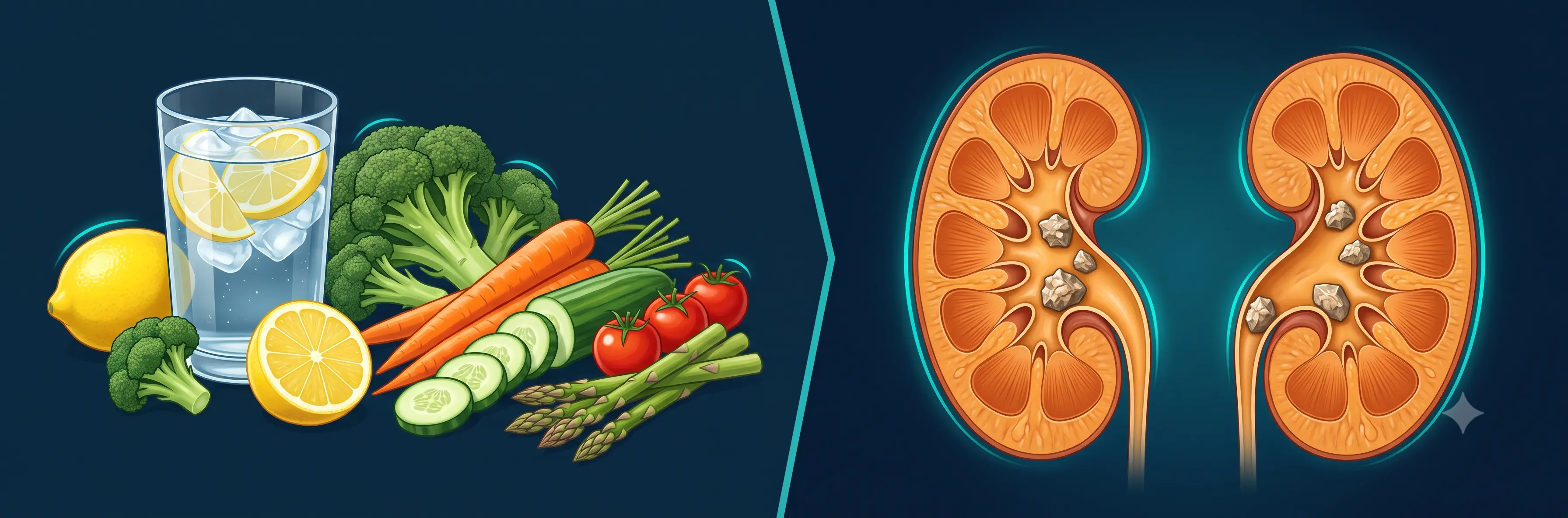
Most kidney stones are not bad luck. They are built, slowly, from the food and water choices made over months and years. The good news is that the same diet that forms stones can be reversed. With a few targeted changes, the recurrence rate drops by more than 50%.
Why diet matters for kidney stones
About 80% of kidney stones are calcium oxalate, formed when calcium and oxalate crystallise in concentrated urine. The remaining 20% are uric acid, struvite, or cystine stones, each driven by different dietary and metabolic factors.
Urine becomes concentrated when you do not drink enough, eat too much salt, or consume foods that dramatically raise oxalate or uric acid in the urine. The kidneys then struggle to keep these minerals dissolved, and crystals begin to form.
The single most important change: drink more water
This is not a cliché. Dilution is the most powerful stone-prevention strategy available. The target is a urine output of 2–2.5 litres per day, which typically requires drinking 2.5–3 litres of fluid.
- Your urine should be pale yellow, not dark yellow or amber
- Spread fluid intake throughout the day. Do not drink all at once
- Increase intake in summer, after exercise, and during illness
- Plain water is best; lemon water adds citrate which actively inhibits stone formation
In Gondia's climate, most stone patients are significantly under-hydrated. This alone is often the primary driver of first-time stones.
Foods that increase kidney stone risk
High-oxalate foods (limit, do not eliminate)
Oxalate binds calcium in the kidney and forms crystals. High-oxalate foods include:
- Spinach (palak): very high oxalate; limit to 1–2 times per week
- Tomatoes: moderate oxalate; fine in normal amounts, avoid excess
- Nuts (especially cashews and peanuts): eat in small quantities
- Chocolate and cocoa
- Beetroot: high oxalate; limit frequency
- Tea: black tea is high in oxalate; switch to lighter versions or reduce quantity
Importantly, eliminating calcium does not help. It makes things worse. Dietary calcium actually binds oxalate in the gut before it reaches the kidneys. Eat normal amounts of dairy with high-oxalate meals.
Excess salt
High sodium causes the kidneys to excrete more calcium in the urine, raising the calcium available to form stones. Most Indians consume 8–10 g of salt per day against a recommended 5 g. Key sources: pickles, papad, processed snacks, restaurant food, and extra salt added at the table.
Animal protein (for uric acid stone formers)
Red meat, poultry, and seafood raise uric acid levels. Patients who form uric acid stones should limit animal protein to one moderate serving per day and increase plant protein (dal, legumes).
Sugary drinks
Cola and fizzy drinks raise the risk of uric acid and calcium oxalate stones. They are also diuretic: they cause more fluid loss than they replace. Replace with water, buttermilk, or coconut water.
Foods that protect against kidney stones
- Lemon and lime juice: rich in citrate, which inhibits crystal formation. A glass of lemon water daily is a simple, effective preventive
- Dairy (milk, curd, paneer): despite containing calcium, dairy reduces stone risk by binding oxalate in the gut
- Coconut water: hydrating and contains potassium which reduces urinary calcium
- Mosambi (sweet lime) and orange juice: citrate-rich
- Fruits and vegetables in general: they alkalinise the urine and reduce stone risk overall
Stone type changes the dietary advice
The right diet depends on what type of stone you have. A urine stone analysis (done after passing or removing a stone) tells you exactly what to target:
- Calcium oxalate: Limit oxalate, keep normal calcium intake, reduce salt
- Uric acid: Reduce animal protein, avoid alcohol, drink more water, alkalinise urine
- Struvite: These are infection-related. Dietary change alone is insufficient; treat the underlying UTI
- Cystine: Very high fluid intake and dietary adjustments guided by a urologist
If you have passed a stone, ask your urologist to send it for analysis. This one investigation personalises your entire prevention plan.
A practical daily checklist: 2.5–3 litres of water · pale yellow urine by midday · lemon in at least one glass of water · reduce salt (no extra at the table) · normal dairy with every oxalate-rich meal · reduce red meat to 3 times per week or less.
When dietary changes are not enough
Some patients form stones despite good dietary habits due to metabolic conditions: hyperparathyroidism, renal tubular acidosis, or hypercalciuria. A 24-hour urine study identifies these. Medication (potassium citrate, thiazide diuretics, allopurinol) is added when diet alone cannot achieve normal urine chemistry.
If you have had more than one stone episode, or your stone was larger than 5 mm, a metabolic evaluation is worth doing, not just dietary advice.
When to see a urologist in Gondia
- You have had a kidney stone before and want to prevent recurrence
- A scan shows a stone currently in your kidney, even if it is not causing pain
- You have pain in the flank, blood in urine, or fever with chills
- A family member has had kidney stones. Risk is partially genetic