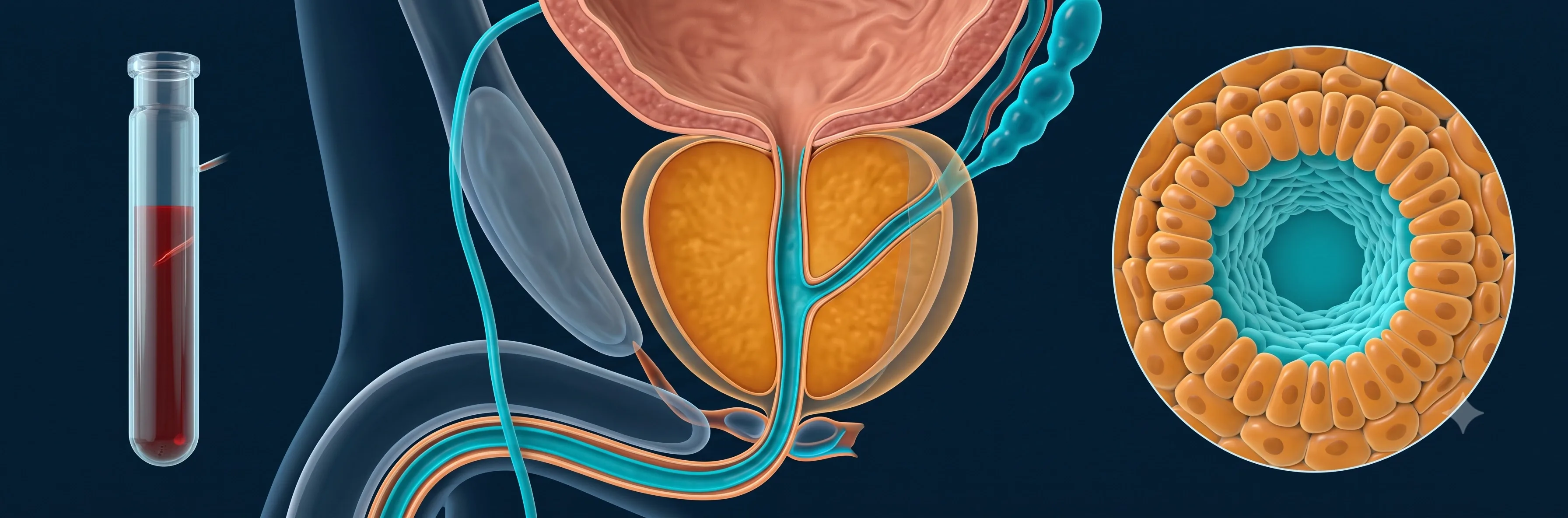
Prostate problems are almost inevitable in ageing men, but most of them are manageable when found early. The problem is that the prostate causes no symptoms until it is already significantly enlarged or, in the case of cancer, already progressing. This is why prostate checks matter, and why 40 is the right age to start.
What does the prostate actually do?
The prostate is a walnut-sized gland that sits just below the bladder and wraps around the urethra. Its job is to produce fluid that protects and nourishes sperm. It has no urinary function, but its location means that when it enlarges, it squeezes the urethra and disrupts urination.
From the age of 40, most men's prostates begin a slow, gradual enlargement driven by hormonal changes. This process, benign prostatic hyperplasia (BPH), is not cancer. But in a minority of men, prostate cells can become malignant, giving rise to prostate cancer, the most common cancer in men worldwide after skin cancer.
Symptoms that suggest a prostate problem
Both BPH and prostate cancer can cause lower urinary tract symptoms (LUTS):
- Weak or slow urine stream
- Difficulty starting urination
- Feeling of incomplete bladder emptying
- Frequent urination, especially at night
- Dribbling at the end of urination
- Urgency, the sudden strong need to urinate
Important: Early prostate cancer usually causes no symptoms at all. Symptoms only appear when the cancer is advanced. This is why screening tests, not symptom monitoring, are the key to early detection.
The PSA test: what it measures and what it means
PSA (Prostate-Specific Antigen) is a protein produced by prostate cells, both normal and cancerous. A blood PSA level is the primary screening tool for prostate cancer.
PSA levels by age (general reference ranges)
| Age Group | PSA Level (ng/mL) | Significance |
|---|---|---|
| 40–49 years | < 2.5 | Normal |
| 50–59 years | < 3.5 | Normal |
| 60–69 years | < 4.5 | Normal |
| 70+ years | < 6.5 | Normal |
Elevated PSA does not automatically mean cancer. BPH, prostatitis (prostate infection or inflammation), vigorous cycling, or even a recent rectal examination can raise PSA temporarily. What matters more than a single high value is the trend over time (PSA velocity) and the ratio of free-to-total PSA.
Digital rectal examination (DRE)
A DRE takes 30 seconds. The urologist inserts a gloved finger into the rectum to feel the prostate through the rectal wall. A normal prostate feels smooth and soft. A hard, nodular, or asymmetrical prostate is suspicious for cancer, even with a normal PSA.
PSA and DRE together are more accurate than either test alone. A man with a normal PSA but an abnormal DRE still needs investigation.
When is a biopsy recommended?
A prostate biopsy is recommended when:
- PSA is elevated and rising on repeat testing
- The DRE is abnormal
- Multiparametric MRI (mpMRI) of the prostate shows a suspicious lesion (PI-RADS 3–5)
Modern biopsy is done under ultrasound guidance, usually as a transperineal or transrectal procedure. It takes 10–15 minutes under local anaesthesia. Results grade the cancer using the Gleason score (or Grade Group 1–5), which determines how aggressively it needs to be treated.
Who should get checked and when
- All men from age 50: Annual PSA and DRE
- Men from age 40 with a family history (father or brother with prostate cancer): Begin PSA from 40
- Men from age 40 with any LUTS: Prostate evaluation including PSA, DRE, and uroflowmetry
- Men from age 45 with diabetes or obesity (both raise prostate cancer risk): Consider starting PSA from 45
Uroflowmetry: the other useful test
Uroflowmetry measures the speed and pattern of your urine stream. You urinate into a special measuring device and the machine records your peak flow rate (Qmax). A normal Qmax is above 15ml/second. Below 10ml/second indicates significant obstruction. This test is painless, takes five minutes, and gives objective data that symptom questionnaires alone cannot.
Don't wait for symptoms to appear. Many men first present for prostate evaluation when they are already struggling to urinate or, in the case of prostate cancer, when the disease has spread. A simple blood test once a year changes this completely.
What BPH and prostate cancer treatment look like in 2026
For BPH that needs treatment, laser surgery (ThuLEP) now replaces the older TURP in many centres, offering faster recovery, less bleeding, and better long-term results. For localised prostate cancer, options range from active surveillance for low-risk disease to robotic-assisted radical prostatectomy or radiation therapy for higher-risk cases.
The key point: treatment chosen at an early stage is almost always simpler, safer, and more successful. That window of opportunity exists only because of a routine annual test.