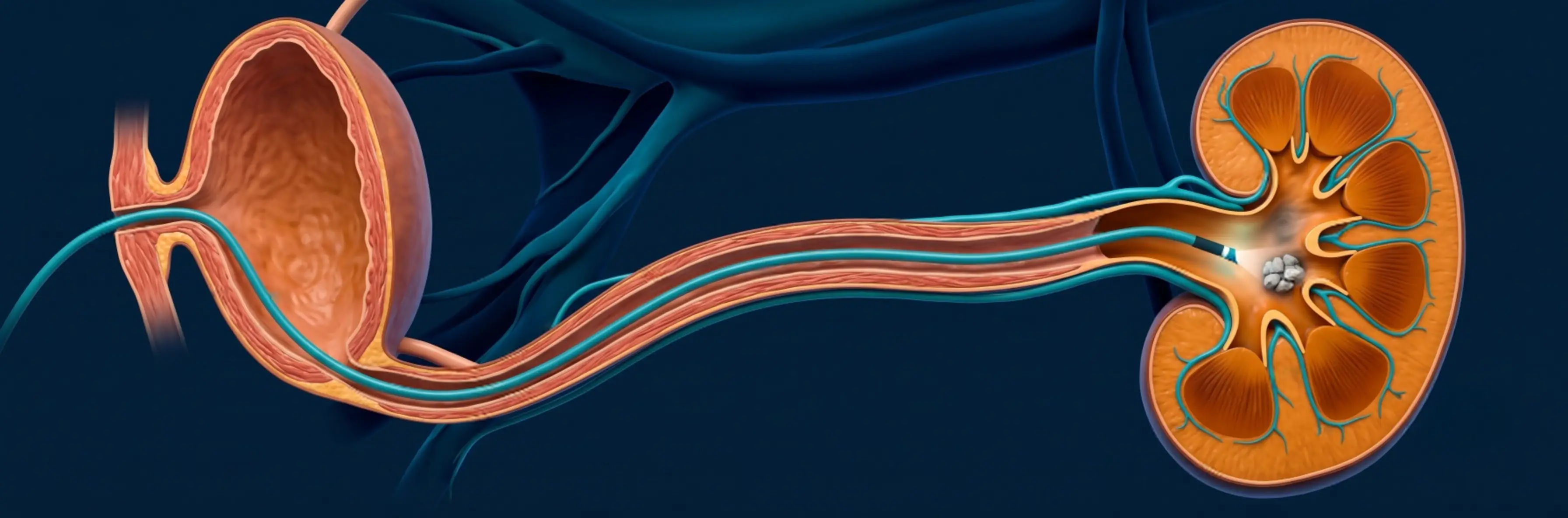
You've been told you have a kidney stone that needs treatment. Now you're facing a choice between two procedures: ureteroscopy (URS) or shock wave lithotripsy (ESWL). Both break down stones, but they work very differently, and the right choice depends on your stone's size, location, and composition.
The short answer
For most kidney and ureteral stones seen in clinical practice today, ureteroscopy with laser lithotripsy gives better stone-free rates with a single treatment. ESWL is non-invasive but works best only for specific stone types in specific locations, and often needs to be repeated.
How each procedure works
Ureteroscopy (URS) with laser
A thin, flexible or semi-rigid telescope is passed through the urethra and bladder into the ureter or kidney without any incision. A laser fibre, usually a holmium or thulium fibre laser, is passed through the scope and used to break the stone into fine dust or small fragments that pass naturally. A temporary ureteral stent is usually placed at the end and removed 1–2 weeks later.
Shock Wave Lithotripsy (ESWL)
High-energy sound waves are focused on the kidney stone from outside the body using X-ray or ultrasound targeting. The waves create pressure that cracks the stone. There is no scope or incision. The patient lies on a table while a machine delivers 2,000–3,000 shocks over 45–60 minutes. Fragments then pass through urine over days to weeks.
Comparing outcomes: what the data shows
| Factor | Ureteroscopy (URS) | ESWL |
|---|---|---|
| Stone-free rate (≤10mm) | 90–95% | 70–85% |
| Stone-free rate (10–20mm) | 85–90% | 50–65% |
| Sessions usually needed | 1 | 1–3 |
| Anaesthesia | Spinal or general | Sedation or none |
| Hospital stay | Day care | Outpatient |
| Recovery to normal activity | 3–5 days | 1–2 days |
| Works on hard stones | Yes | Less effective |
When ESWL is the better choice
ESWL works best when:
- The stone is small (under 10mm) and in the upper ureter or kidney
- The stone is soft (calcium oxalate dihydrate, struvite)
- The patient prefers to avoid any form of internal scope
- There are no anatomical abnormalities blocking fragment passage
- The patient is not on blood thinners (ESWL causes minor bruising around the kidney)
When ureteroscopy is the better choice
URS is preferred when:
- The stone is larger than 10mm
- The stone is hard (calcium oxalate monohydrate, cystine)
- The stone is in the lower ureter (ESWL fragments struggle to pass from here)
- ESWL has already failed once
- The patient is obese (ESWL focusing becomes inaccurate)
- The patient is pregnant (ESWL is contraindicated; URS is the only safe surgical option)
- There is a ureteral stricture or anatomical blockage
What about PCNL?
For large stones (above 20mm) or staghorn calculi that fill the entire kidney pelvis, neither URS nor ESWL is sufficient. These require PCNL (percutaneous nephrolithotomy), a small puncture into the kidney to directly remove the stone. This is a separate category of treatment and not covered here.
The Urocare approach
At Urocare Hospital Gondia, we perform flexible ureteroscopy with laser lithotripsy using a holmium laser system. Before recommending a procedure, we review the stone's size on CT scan, assess its density in Hounsfield units (a predictor of hardness), and factor in the patient's overall health and preferences.
For straightforward mid-ureteral or lower ureteral stones, we typically recommend URS and laser as the single-session solution. For incidentally detected small renal stones with no obstruction, we often advise active surveillance before any intervention.
A CT scan, not a plain X-ray, is essential before planning kidney stone treatment. Many stones are not visible on plain X-ray, and CT gives precise information about size, density, and location that directly determines which procedure is appropriate.
Questions to ask your urologist before deciding
- What is the exact size and location of my stone?
- What is its estimated density, is it likely to be hard or soft?
- What is the one-session stone-free rate for my specific stone with each option?
- If ESWL is chosen and it doesn't work, will I still need URS?
- Am I on any medication (blood thinners, aspirin) that affects either procedure?